ZK vs Optimistic Rollups 2026: Security and Exit Audit
ZK vs Optimistic Rollups 2026: Security and Exit Audit
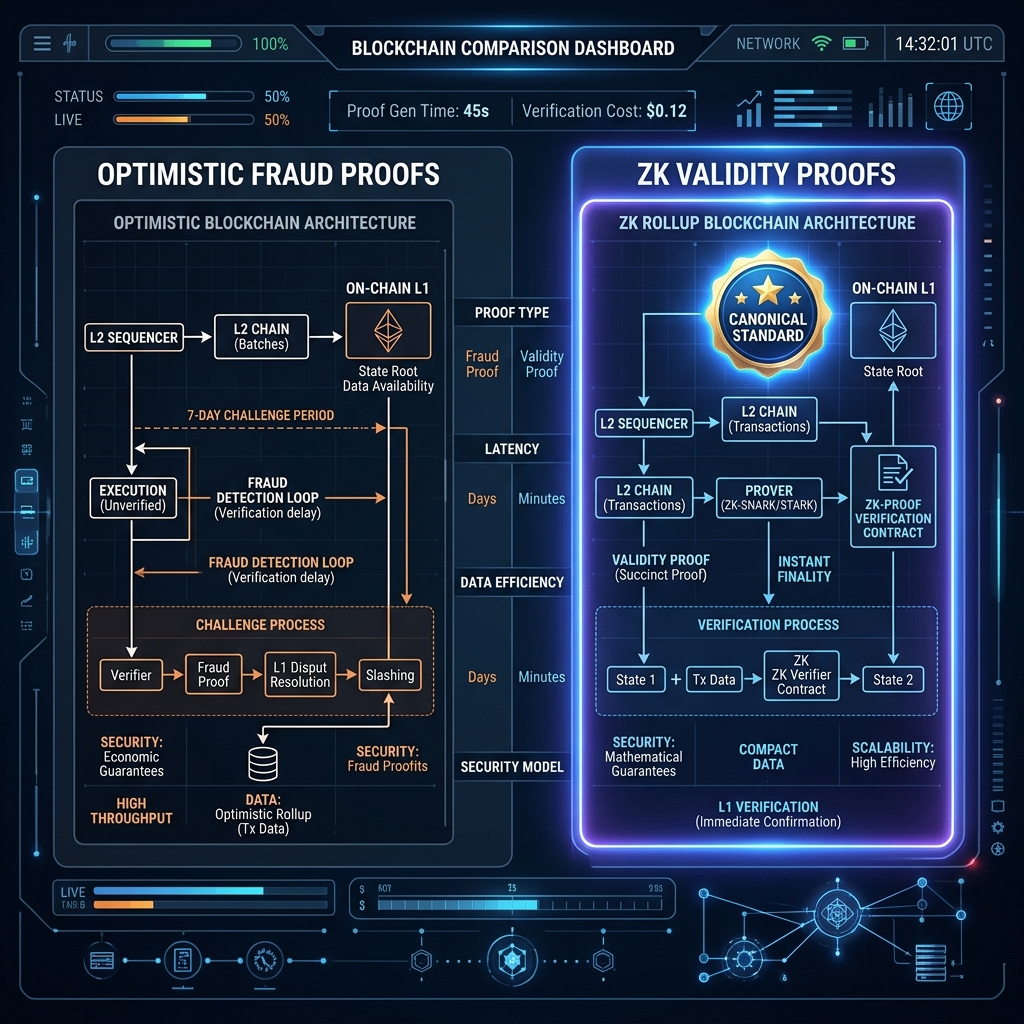
Short answer: Neither validity rollups nor optimistic rollups are categorically safer, faster, or cheaper. Validity proofs can remove the challenge period from protocol settlement, but a live chain can still delay withdrawals while it forms batches, generates proofs, posts them to Ethereum, waits through a safety time lock, or processes a bridge message. Optimistic systems retain a dispute window for canonical L2-to-L1 exits, but ordinary L2 transactions can reach Ethereum-backed finality much sooner. The useful comparison is chain by chain, not slogan by slogan.
This distinction matters because an investor sees a bridge timer, a developer sees a virtual machine, and a risk manager sees a collection of contracts, keys, emergency powers, and operational dependencies. All three may call the subject "finality" while measuring different events.
Our conclusion is not that one proof family has won. It is that the old two-column comparison has become inadequate. A serious 2026 audit must inspect at least six layers: transaction ordering, execution correctness, data availability, Ethereum settlement, withdrawal mechanics, and administrative control. A chain can be strong in one layer and weak in another.
The Comparison in One Table
| Audit question | Optimistic rollup | Validity rollup | What an analyst should verify |
|---|---|---|---|
| How is an invalid state claim rejected? | An honest challenger can dispute a claim during a defined window using a fault-proof system | An L1 verifier accepts only a state transition accompanied by a valid cryptographic proof | Is the production proof system permissionless, active, and used by the canonical bridge? |
| When is an ordinary L2 payment usable? | Usually after sequencer inclusion; stronger assurance arrives after data reaches L1 | Usually after sequencer inclusion; proof-backed settlement arrives later | Distinguish preconfirmation, safe head, L1 inclusion, and settlement |
| When is a canonical L2-to-L1 exit available? | Normally after the state proposal and challenge period; fast bridges substitute liquidity | After the relevant batch is proved and executed, subject to any protocol time lock and bridge process | Measure the actual canonical bridge, not a third-party bridge quote |
| Where is transaction data stored? | Normally on Ethereum calldata or blobs for a rollup | On Ethereum for a rollup; another DA system or committee for a validium | Confirm the deployed chain's mode, retention, and forced-exit path |
| What extra liveness dependency exists? | Proposers, challengers, fault-proof software, and L1 access | Prover capacity, proof aggregation, verifier contracts, and L1 access | Test the recovery procedure when the normal operator stops |
| What can governance change? | Contracts, proof implementation, sequencer rules, bridge controls, and emergency state | Contracts, circuits, verifier keys or code, DA configuration, bridge controls, and emergency state | Record upgrade delay, signer threshold, guardian powers, and exit window |
| Is EVM behavior identical? | Often close to Ethereum, but chain configuration still matters | Varies by zkVM and compiler; compatibility is implementation-specific | Run contract-level tests instead of accepting an ecosystem label |
The table gives a more defensible answer than claims such as "ZK means instant" or "optimistic means seven-day finality." Those phrases collapse several clocks into one.
First Principle: Compare Mechanisms, Then Deployments
An optimistic rollup publishes transaction data and a claim about the resulting state. The protocol gives independent participants time to challenge a bad claim. Security therefore depends on the data being available, at least one honest participant being able to reconstruct the state, and the dispute mechanism resolving correctly before an invalid claim can authorize an L1 withdrawal.
A validity rollup publishes a state commitment and a cryptographic proof that the transition followed the rules encoded in its proving system. An Ethereum contract verifies that proof. Security therefore depends on the circuit or virtual machine expressing the intended rules, the prover producing a proof, the verifier accepting only valid proofs, and users retaining access to enough data to reconstruct balances and exit.
The mechanisms answer the narrow question, "Was this state transition accepted under the protocol's rules?" They do not answer whether an oracle price was economically sensible, whether a user signed a malicious approval, whether a governance key was compromised, or whether an external data-availability provider will keep publishing data. A valid proof can faithfully prove execution of a bad application rule.
The second step is deployment analysis. "OP Stack" is software, not one universal security configuration. A chain can use permissioned state proposals, permissionless fault proofs, custom data availability, a centralized sequencer, or different upgrade controls. The same is true of a ZK stack: one deployment may be an Ethereum rollup while another is a validium with offchain data.
That is why we avoid averaging Optimism, Arbitrum, ZKsync, Starknet, and Polygon into two imaginary chains. The family describes the settlement method. The deployed contracts and operating policy define the actual risk.
Four Finality Clocks, Not One
Finality comparisons often fail before the numbers are collected because the analyst has not defined the clock. A useful audit records four separate milestones.
1. Sequencer inclusion
The sequencer acknowledges and orders the transaction. This is the fast confirmation shown by most wallets and applications. It is useful for user experience, but it is not the same as Ethereum settlement. If the sequencer has not yet posted the data, users are relying on the chain's ordering service and recovery rules.
2. Data publication to Ethereum
The batch data reaches Ethereum, usually in blobs or calldata. At this point independent nodes can derive the L2 history under the protocol's rules. An Ethereum reorganization can still matter until the containing L1 block receives the desired level of confirmation.
Optimism's current documentation makes a particularly important distinction: ordinary OP Mainnet transactions do not wait seven days to become final. Its finality page describes escalating stages from fast sequencer inclusion to Ethereum-backed finality. The seven-day period applies to canonical withdrawals and L2-to-L1 messages that rely on the fault-proof process, not every payment made on the L2.
3. State settlement
For an optimistic system, a state proposal must survive its dispute period. For a validity system, the relevant proof must be generated, submitted, verified, and accepted. Neither event necessarily happens at the same time as a user's first confirmation.
The ZKsync protocol documentation is a useful counterexample to "instant ZK finality." It describes batch formation, commitment, proof generation, proof submission, and execution, and currently estimates full finality around hours rather than seconds. Its security documentation also describes a minimum execution delay controlled through a validator time-lock arrangement, with possible additional batching time. These are deployment facts, not a flaw in validity proofs. They simply show why proof architecture and observed exit latency are different variables.
4. Withdrawal availability
The final clock starts when a user requests an L2-to-L1 exit and stops when the asset is spendable on L1. This can include waiting for a batch, an output proposal, a proof, a challenge window, a time lock, L1 confirmation, a Merkle inclusion proof, and a second finalize transaction.
An article that reports one "finality time" without naming the milestone is not decision-grade research.
Worked Example: Two Users Exit to Ethereum
Consider Maya, who withdraws ETH through OP Mainnet's canonical bridge, and Daniel, who withdraws through a validity-rollup canonical bridge. Both initiate at noon on Monday.
Maya's optimistic exit
Maya may instead use a fast bridge. In that case a liquidity provider pays her on L1 early and later claims the canonical withdrawal. The challenge period has not vanished. The provider has priced the delay, execution risk, liquidity cost, and bridge risk into the fee. This is economically useful, but it is not equivalent to changing the base protocol's settlement rule.
Daniel's validity exit
Daniel avoids an optimistic dispute window, but his exit is not necessarily immediate. ZKsync's official bridge documentation, for example, requires the L2 withdrawal followed by L1 finalization after the relevant message is available; its current protocol security design also imposes a minimum execution delay. Another validity rollup can have a different sequence.
The worked example exposes the right question: not "Which family is instant?" but "What events must occur on this deployed canonical path, who can delay each event, and what escape path remains if they stop?"
Data Availability Can Reverse the Ranking
Validity proves correct execution under a stated input. It does not, by itself, make the underlying transaction data available to users. Without sufficient state data, users may be unable to reconstruct balances, submit state updates, or prepare an independent exit even when the accepted state root is mathematically valid.
An Ethereum rollup posts the necessary data to Ethereum. A validium stores it elsewhere and uses a committee, another network, or a custom availability mechanism. The validium may reduce fees, but the user takes on a different freezing or censorship risk.
ZKsync's own chain documentation is explicit about this tradeoff. It recommends rollup data availability for most chains and notes that a validium operator can make funds unavailable by withholding data even when the validity system prevents arbitrary theft through an invalid state transition. Its Gateway documentation also separates rollup chains that relay public data to Ethereum from validium and custom-DA configurations.
That distinction produces a counterintuitive result. A well-operated optimistic rollup with Ethereum data availability and a tested, permissionless fault-proof system can offer a stronger exit guarantee than a validity-based validium whose operator controls the data. "ZK" is not a substitute for checking where the bytes live.
For each chain, record:
The Fault-Proof Audit
The optimistic security story requires more than a white paper saying that fraud can be challenged. The production system must make the relevant actions possible under realistic conditions.
OP Mainnet activated permissionless fault proofs in June 2024 according to Optimism's documentation. Anyone can submit state proposals and challenge them, while a Guardian retains powers that can pause withdrawals, blacklist dispute games, or switch the respected game type as a security backstop. That is meaningful decentralization progress, but it also means the administrative layer remains part of the risk model.
An analyst should verify five properties:
The one-honest-party assumption is powerful only when one honest party has the data, software, capital, and time to act.
The Validity-Proof Audit
The validity side replaces the dispute race with a different set of engineering questions.
Circuit and VM correctness
The proof demonstrates that computation satisfied the implemented circuit. A bug in the circuit, compiler, witness generation logic, verifier, or upgrade can make the implemented rules differ from the intended rules. Multiple audits, public code, test vectors, bug bounties, and independent implementations reduce this risk; the word "mathematical" does not remove it.
Prover liveness
Proof generation is an operating service. If the only prover fails or withholds proofs, invalid state should not settle, but valid withdrawals can remain unavailable. An audit should identify who can prove, whether proving is permissionless in practice, the hardware and software requirements, backlog behavior, and the protocol's recovery mode.
Batching policy
A prover can be fast while users still wait because the operator delays closing a batch to amortize L1 and proving costs. Low-activity chains can therefore have longer settlement latency than headline proof benchmarks imply. Measure user transaction to accepted L1 state, not laboratory proof time.
Proof-system assumptions
Proof systems differ in trusted setup requirements, cryptographic assumptions, proof size, prover cost, and verifier cost. These choices deserve review, but they do not support a universal claim that every STARK, SNARK, zkVM, or zkEVM has the same security or performance.
Upgrade and emergency controls
Validity-rollup contracts are often upgradeable while their proving systems mature. The signer threshold, time delay, emergency freeze, scope of an upgrade, and users' ability to exit before activation can dominate the theoretical proof advantage.
Cost: Why "ZK Price Parity" Is Not a Fact
There is no defensible universal price-parity number between the two families. A user's fee is a bundle of costs: L2 execution, data publication, proof or fault-proof operations, batch frequency, operator margin, congestion policy, and bridge activity.
Validity systems incur proof generation and L1 verification costs, but can compress some information efficiently and amortize fixed costs over a large batch. Optimistic systems avoid proving every normal batch, but still pay for data publication and maintain fault-proof infrastructure. Both benefit from cheaper Ethereum blob data. Both can subsidize fees or tune margins, making a public gas quote an imperfect measure of underlying economics.
The comparison also changes with workload. Simple transfers, storage-heavy DeFi transactions, signature verification, and unusual precompiles stress different parts of a VM or proving circuit. Hardware acceleration may lower proving cost, but it does not establish a permanent industry-wide parity point.
A useful cost study reports median and tail user fees, batch fullness, data cost per transaction, proof cost per batch, bridge cost, subsidy policy, and the period measured. It does not infer architecture economics from one quiet-hour swap.
EVM Compatibility Is a Test Matrix
Optimistic systems historically gained an adoption advantage by reusing Ethereum execution software and developer tooling. Validity systems have narrowed that gap through zkEVMs, custom EVM interpreters, and compiler improvements. Still, "EVM compatible" and "EVM equivalent" are not binary guarantees.
A deployment team should test:
The right answer depends on the application. A Solidity contract compiling successfully proves less than a full integration test across deposit, execution, oracle update, liquidation, pause, and withdrawal paths.
Interoperability Does Not Eliminate Bridge Risk
The OP Superchain, ZKsync's network of chains, Polygon's aggregation work, and other multi-chain systems aim to make separate chains feel more unified. Their designs differ, and roadmap language should not be reported as deployed security.
Optimism's own Upgrade 16 documentation made this distinction clearly: it introduced contracts described as interop-ready but stated that the upgrade did not turn interoperability on. Current Superchain token documentation likewise says the token standard can be deployed while cross-chain behavior still depends on interop being enabled for the relevant cluster.
Cross-chain systems add new questions:
A shared sequencer is not automatically a single point that pauses every participating chain, and proof aggregation is not automatically decentralized. Those outcomes depend on fallback sequencing, force-inclusion paths, contract design, and operator sets. Each claim must be checked against the live deployment.
Decision Framework by Application
| Application | Highest-priority property | Architecture tendency | Due diligence that can change the answer |
|---|---|---|---|
| Consumer payments | Fast confirmations, low predictable fees, reliable wallet support | Either family can work | Sequencer outages, bridge dependency, fee tails, stablecoin issuer support |
| High-value DeFi settlement | Ethereum DA, mature contracts, credible exit, limited upgrade power | Prefer the strongest deployed security configuration, regardless of family | Fault/proof maturity, oracle design, governance delay, TVL concentration |
| Onchain games | Low fees, high throughput, custom execution | Validium or application chain may be rational | Data withholding consequences, asset portability, operator recovery |
| Institutional asset issuance | Controlled operations, auditability, legal transfer rules, deterministic exits | Chain-specific; proof family is secondary | Admin keys, privacy model, freeze controls, custodian and issuer obligations |
| Privacy application | Confidential state and selective disclosure | Specialized ZK design may be necessary | Privacy is not automatic in a public ZK rollup; inspect what is hidden and from whom |
| General Solidity deployment | Tool compatibility, liquidity, indexers, reliable infrastructure | Mature EVM-oriented deployment | Test every required opcode, RPC, bridge, oracle, and emergency path |
| Appchain network | Upgrade coordination, interoperability, DA choice, sustainable operations | Stack choice depends on operator capability | Shared dependencies, proof cost at low volume, fallback mode, governance boundaries |
The framework deliberately gives no automatic winner. A game may knowingly accept external DA to lower cost. A lending protocol holding large collateral may reject the same tradeoff. Architecture is a risk budget, not a league table.
A 12-Point Rollup Scorecard
Use this checklist before depositing meaningful value or selecting an application platform. Score evidence, not promises.
We would weight data availability, canonical exit, and upgrade control more heavily than raw transaction throughput for assets intended to remain economically significant. Throughput can be improved later. A trapped or governance-seized asset is a more fundamental failure.
Failure Scenarios Worth Rehearsing
The sequencer disappears
Both families commonly use centralized sequencing today. The immediate issue is liveness and censorship, not necessarily theft. Check whether users can submit through L1, how quickly forced messages are processed, and whether another operator can resume block production.
The prover stops
A validity chain may keep issuing soft confirmations while no new state is proved, depending on its design. Applications should define when they stop accepting deposits or high-value transfers as the unproved backlog grows. Users need to know whether an alternate prover can take over.
Every normal challenger is offline
An optimistic system relies on at least one capable honest challenger during the dispute window. Monitoring diversity matters. A permissionless contract is not sufficient evidence if only one organization has the operational stack and capital to act.
Data is withheld
For an Ethereum rollup, posted data allows independent reconstruction subject to data retrieval infrastructure. For a validium, withholding can freeze user action even when the proof prevents an invalid balance transition. Recovery may depend on a committee or governance intervention.
Governance pushes a bad upgrade
Both proof families can be undermined by rapid administrative change. A mature setup gives users visible notice, a delay long enough to exit, constrained emergency powers, and transparent signer policy. "Secured by Ethereum" should never be interpreted as "has no governance keys."
What the 2026 Evidence Supports
The strongest conclusion is convergence at the tooling layer, not the disappearance of optimistic settlement. OP Stack developers can experiment with alternative proof systems, including validity and hybrid approaches. ZK systems continue to improve EVM support and multi-chain coordination. Those developments expand design choice.
They do not prove that 80% of new OP chains use ZK, that specialized hardware created universal cost parity, that OP Mainnet replaced its canonical fault-proof path, or that all validity-rollup exits are instant. We found no primary evidence for those claims and removed them from this analysis.
The practical 2026 hierarchy is:
Frequently Asked Questions
Are ZK-rollup withdrawals instant?
Not necessarily. A validity proof removes the need for an optimistic challenge window, but a user may still wait for batch formation, proof generation, proof aggregation, Ethereum submission, a protocol safety delay, L1 confirmation, and bridge finalization. Check the canonical bridge's current process for the specific chain.
Do optimistic-rollup transactions take seven days to finalize?
No. Ordinary L2 transactions can receive sequencer confirmation quickly and gain stronger assurance when their data is included and finalized on Ethereum. The commonly cited seven days applies to canonical L2-to-L1 withdrawals and messages on systems such as OP Mainnet because the state claim remains challengeable during that period.
Is a fast bridge the same as a fast canonical withdrawal?
No. A fast bridge usually advances L1 liquidity and later collects the canonical withdrawal. The user exchanges waiting time for a fee and accepts the bridge's smart-contract, liquidity, and counterparty design.
Does a validity proof guarantee data availability?
No. It proves that a state transition satisfies the encoded rules. A rollup also publishes the data needed to reconstruct state, while a validium uses another availability arrangement. Data withholding can freeze users even if an operator cannot prove an invalid transition.
Is every OP Stack chain secured like OP Mainnet?
No. Chains can differ in proof activation, data availability, sequencer policy, bridge contracts, upgrade keys, guardian powers, and operating maturity. Audit the deployed chain rather than inheriting assumptions from the stack name.
Has ZK replaced optimistic rollups?
No. Validity proving is becoming easier to integrate and optimistic stacks can support alternative proof paths, but production chains still use different settlement systems. Hybrid and multi-proof designs may grow without making either mechanism obsolete.
Which architecture is best for a new application?
Choose after ranking the application's real constraints: asset value, exit assurance, data availability, EVM behavior, latency, privacy, cost, operator capability, and governance tolerance. Then compare live deployments with the scorecard above. Proof family is one input, not the decision.
Sources and Method
This audit uses protocol documentation available on July 11, 2026. We separate documented production behavior from CryptosEyes analysis and do not treat roadmap features as active.
For the broader market structure, read our <a href="/insights/layer-2-wars-2026">Ethereum Layer 2 evolution analysis</a>. Developers comparing ecosystem consolidation should continue with <a href="/insights/ethereum-2026-l2-consolidation-thesis">the 2026 L2 consolidation thesis</a>, while risk teams can connect settlement choices to <a href="/insights/institutional-rwa-tokenization-2026">our institutional tokenization audit</a>.
What to Read Next
Read <a href="/insights/layer-2-wars-2026">Ethereum Layer 2 Wars 2026</a> next. It moves from this mechanism audit to the competitive layer: liquidity, distribution, developer tooling, interoperability, and the economics that decide whether technically credible chains attract durable use.
This article is educational research, not investment advice. Protocol configurations can change through upgrades. Verify current contracts, documentation, and withdrawal behavior before committing assets.
Source & Review Basis
This article is reviewed against the source types below. Source links are provided to help readers verify primary documents, market context, and methodology independently.
How treasury data, market metrics, and corrections are reviewed.
Primary source for US public-company filings and treasury disclosures.
Primary technical reference for Ethereum, rollups, staking, and protocol design.
Layer-2 risk, TVL, and architecture reference for scaling-network research.