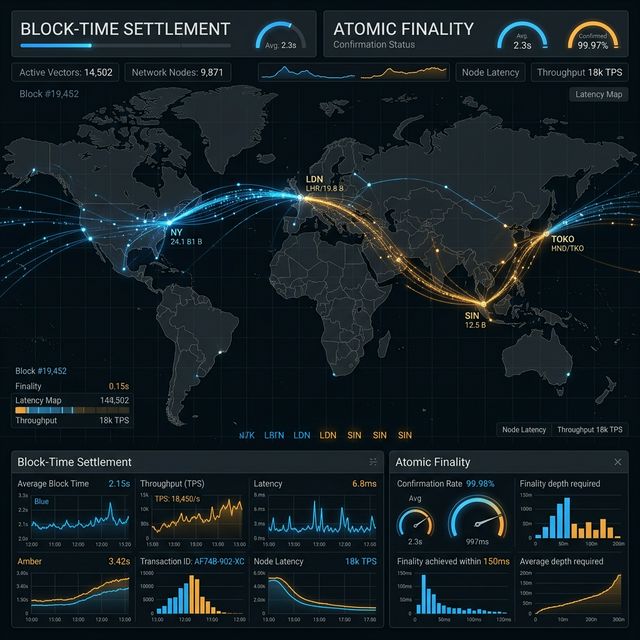
Sovereign Digital-Asset Settlement in 2026: Finality, Liquidity, and Evidence
Sovereign Digital-Asset Settlement in 2026: Finality, Liquidity, and Evidence
Short answer: Governments and large banks are testing tokenized settlement, but there is no verified migration of global liquidity to Bitcoin or BitVM. The strongest 2026 evidence is much narrower: Project Agora has built a wholesale cross-border prototype using tokenized central-bank reserves and commercial-bank deposits; mBridge reached minimum viable product status; and the United States holds forfeited bitcoin as a reserve asset. These are three different activities. A credible analysis must separate settlement infrastructure, reserve ownership, and experimental bridge technology.
This distinction matters because the phrase on-chain settlement can make unlike systems sound interchangeable. A central bank can tokenize reserves without using a public blockchain. A treasury can hold bitcoin without paying suppliers in bitcoin. A bank can transfer a token while its legal claim, redemption process, foreign-exchange conversion, and compliance checks remain off-chain. Faster messaging is not final settlement, and a cryptographic transaction is not automatically legally final.
This guide provides a practical way to evaluate sovereign digital-asset settlement claims. It focuses on six questions: what asset settles the obligation, who controls the ledger, when the payment becomes legally final, where liquidity comes from, how compliance works, and what evidence shows that the system is live.
The Evidence in One Table
| Development | Verified status by July 2026 | Settlement asset | What it proves | What it does not prove |
|---|---|---|---|---|
| BIS Project Agora | Prototype completed; future real-value testing planned | Tokenized central-bank reserves and tokenized commercial-bank deposits | A shared programmable platform can coordinate multi-currency wholesale payments | That it is a production global payment network or uses Bitcoin |
| Project mBridge | Reached MVP stage in mid-2024 | Wholesale central-bank digital currencies | Multiple central banks can test direct cross-border CBDC and FX settlement | Universal adoption, unrestricted access, or replacement of correspondent banking |
| U.S. Strategic Bitcoin Reserve | Established by executive order in March 2025 | Forfeited BTC held by the federal government | A sovereign can classify and retain bitcoin as a reserve asset | That the United States settles payments on Bitcoin or bought BTC on the open market |
| BitVM2 | Research design, implementation work, and a mainnet challenge demonstration | BTC locked through an optimistic bridge design | Bitcoin can verify disputed off-chain computation without a consensus fork | A live sovereign bond market, instant finality, or a risk-free Bitcoin L2 |
| Fast-payment-system links | Production or pilot status varies by corridor | Commercial-bank money settled through central-bank arrangements | Existing systems can improve speed without public blockchains | Atomic delivery-versus-payment for every asset and currency |
The pattern is not a winner-takes-all move to one chain. It is a search for better coordination among central-bank money, commercial-bank deposits, securities, foreign exchange, and compliance systems.
First Separate the Four Sovereign Activities
1. Reserve ownership
A government owns an asset on its balance sheet. Gold, foreign currency, sovereign bonds, and bitcoin can all fit this category under different legal mandates. Reserve ownership concerns custody, valuation, authority to buy or sell, auditability, and policy purpose.
The March 6, 2025 U.S. executive order created a Strategic Bitcoin Reserve funded initially with BTC that the government already owned through final forfeiture. It directed that deposited BTC not be sold and allowed officials to examine budget-neutral acquisition strategies. That is consequential reserve policy. It is not evidence that taxes, Treasury securities, interbank payments, or foreign-exchange trades settle on Bitcoin.
2. Payment messaging
A message tells institutions who should pay whom. SWIFT is commonly discussed as though it holds and transfers all the underlying money, but its central role is secure financial messaging. Actual settlement occurs through accounts, correspondent banks, payment systems, and central-bank infrastructure. Replacing or improving a message does not by itself remove credit, liquidity, or settlement risk.
3. Settlement
Settlement discharges the financial obligation. For a domestic bank payment, that may happen through transfers of central-bank reserves. For a securities trade, cash and securities legs may move through separate infrastructures. The most valuable form is often delivery-versus-payment: the asset moves if and only if the cash moves.
4. Tokenization and programmability
Tokenization represents a claim or asset on a programmable ledger. It can reduce reconciliation and allow conditional transfers. Yet the token inherits its usefulness from the legal and financial system behind it. A tokenized bank deposit is a claim on a commercial bank. A wholesale CBDC is a central-bank liability. A stablecoin is generally a claim governed by the issuer's terms and reserve structure. BTC is a bearer-like digital asset without a redemption promise from an issuer.
Collapsing these categories produces bad analysis. A sovereign BTC reserve does not validate a BTC payment system. A CBDC pilot does not validate a privately issued stablecoin. A fast ledger does not guarantee a liquid market.
What Project Agora Actually Demonstrated
The Bank for International Settlements and the Institute of International Finance convened Project Agora with eight central banks and more than 40 private financial institutions. On May 27, 2026, the BIS said the project had demonstrated a prototype for multi-currency wholesale cross-border payments using tokenized central-bank reserves and tokenized commercial-bank deposits.
The design is important for two reasons.
First, it keeps central-bank money as the settlement anchor. Commercial banks can create deposit money and provide customer services, while central-bank reserves preserve settlement in the safest domestic monetary asset. This reflects the existing two-tier monetary system rather than replacing banks with an unbacked network token.
Second, it places related steps on a programmable platform. A conventional cross-border payment may involve sanctions screening, foreign-exchange conversion, several correspondents, nostro accounts, cut-off times, and repeated reconciliation. A shared platform can make parts of the process conditional and coordinated. In principle, the payer's debit, FX transaction, reserve transfer, and beneficiary credit can be arranged so that one leg does not complete while another fails.
But the BIS is explicit about the limit: Agora delivered a prototype, not a finished product. The next stage is expected to include real-value transactions involving selected currencies and participants. Real-value testing is stronger evidence than a simulation, but it still differs from broad production use with published uptime, volume, failure, cost, and liquidity data.
This leads to a useful rule: do not call a project live merely because real money appears in a controlled test. Production status requires a continuing service, defined participant access, operational accountability, legal finality, incident procedures, and measurable recurring activity.
What mBridge Adds to the Picture
Project mBridge explored a different architecture: a shared distributed ledger for multiple wholesale CBDCs. Its original participants included the central banks or monetary authorities of China, Hong Kong, Thailand, and the United Arab Emirates, with Saudi Arabia joining in 2024. The BIS says the project reached minimum viable product stage in mid-2024.
The attraction is directness. Instead of passing a payment through a chain of correspondent banks, eligible institutions can hold and transfer participating wholesale CBDCs on a shared platform. Foreign exchange can be coordinated with the payment. That can reduce pre-funding and the uncertainty caused by different operating hours.
The hard questions do not disappear:
An MVP proves that a coherent system can be assembled. It does not prove that every corridor has enough liquidity, that governance will survive geopolitical conflict, or that commercial banks will prefer it to upgraded correspondent banking.
Why Bitcoin Is a Different Settlement Proposition
Bitcoin offers a globally replicated ledger, a known issuance schedule, and the ability to transfer BTC without relying on a bank deposit issuer. Those properties can make it attractive as a reserve asset or as collateral. They do not make BTC a neutral substitute for dollars, euros, yen, or other sovereign liabilities in ordinary settlement.
Three mismatches stand out.
Unit-of-account mismatch
A Canadian importer may owe a Japanese supplier yen for machinery. Settling through BTC creates two conversions unless the contract itself is denominated in BTC: Canadian dollars to BTC, then BTC to yen. Each conversion introduces spread, market impact, execution timing, and tax or accounting questions. A shared platform using tokenized CAD and JPY can preserve the contractual units of account.
Finality mismatch
A Bitcoin transaction becomes increasingly difficult to reverse as blocks accumulate, but legal finality is not simply a block count. Parties must know when their obligation is discharged under applicable law. They also need rules for mistaken payments, fraud, insolvency, sanctions, and chain disruption. Probabilistic technical settlement and statutory payment finality answer different questions.
Liquidity mismatch
Bitcoin trades around the clock, but trading availability is not the same as guaranteed depth at a known price. A large public payment can move the market, expose execution intent, or require intermediaries to warehouse volatility. Sovereign currencies already have central banks, dealers, payment systems, and intraday liquidity facilities designed around obligations denominated in those currencies.
Bitcoin may therefore play one role while tokenized sovereign money plays another. A treasury could hold BTC, a bank could accept BTC as collateral with a conservative haircut, and the final invoice could still settle in central-bank money.
BitVM2: Important Research, Not a Sovereign Rail
BitVM and BitVM2 are often described too loosely as smart contracts running on Bitcoin. The more accurate description is optimistic verification. Complex computation occurs off-chain; Bitcoin scripts help resolve a dispute when a claimed result is challenged. This can support bridge designs without changing Bitcoin's consensus rules.
The BitVM2 research improves the trust model of a Bitcoin bridge. Its authors describe an existential-good-faith assumption for setup: security can hold if at least one participant follows the protocol. A production-level implementation has been developed, and the researchers report a full challenge verification on Bitcoin mainnet. That is meaningful engineering progress.
It is not the same as a mature bridge carrying sovereign value. An institution still needs to evaluate:
Atomic settlement also needs careful wording. A protocol may make two digital legs conditional, but users can still face bridge, oracle, custody, governance, and legal risks. Atomicity narrows one failure mode; it does not eliminate counterparty risk from the wider transaction.
A Worked Cross-Border Settlement Example
Consider a U.S. manufacturer paying EUR10 million to a German supplier. The invoice is due at 10:00 Frankfurt time. Compare three stylized routes. These figures are analytical assumptions, not quoted market prices.
Route A: correspondent banking
The manufacturer's bank debits dollars, obtains euros through an FX trade, and sends payment instructions through correspondent relationships. The German bank credits the supplier after its controls and receipt conditions are satisfied. The route may work reliably, but the parties can face cut-off times, uncertain fee deductions, trapped nostro liquidity, and limited end-to-end visibility.
Route B: tokenized deposits with central-bank settlement
The U.S. bank represents an eligible dollar deposit on a shared platform. A market maker supplies the USD/EUR conversion. Tokenized central-bank reserves settle the wholesale cash obligations, while the German bank issues or transfers the euro deposit claim to its customer. Programmable conditions can coordinate compliance, FX, and payment legs.
The principal benefit is not that the ledger says blockchain. It is that fewer institutions reconcile separate records and fewer steps can become stranded. The unresolved issues are access, privacy, legal recognition, liquidity outside normal hours, and failure recovery.
Route C: BTC bridge settlement
The U.S. bank or customer buys BTC, transfers or locks it through a bridge, and the German side sells BTC for euros. If BTC moves 1% during execution, the gross exposure is EUR100,000 before spreads and fees. Hedging can reduce that exposure, but the hedge adds another venue, collateral requirement, and counterparty. If a bridge withdrawal has a challenge delay, the supplier may not have usable euros at the contractual deadline.
Route C may make sense when both parties want BTC, when banking access is poor, or when the transaction explicitly values censorship resistance over price certainty. It is not automatically the cheapest route for a fiat-denominated commercial obligation.
The decision calculation
For each route, estimate total expected cost as:
Expected cost = explicit fees + FX spread + liquidity carry + collateral cost + expected loss from failure + operational cost
Suppose the assumptions are:
| Cost component | Correspondent route | Tokenized bank-money route | BTC bridge route |
|---|---|---|---|
| Explicit and network fees | 8 basis points | 4 basis points | 5 basis points |
| FX spread and market impact | 6 bp | 4 bp | 12 bp across two conversions |
| Liquidity and collateral carry | 5 bp | 2 bp | 8 bp |
| Modeled operational/failure cost | 2 bp | 3 bp while new | 10 bp for bridge and execution risk |
| Illustrative total | 21 bp | 13 bp | 35 bp |
On EUR10 million, those totals are EUR21,000, EUR13,000, and EUR35,000. Change the inputs and the result can change. A poorly liquid tokenized corridor could cost more than correspondent banking; a BTC-native transaction could avoid the two FX legs. The framework is more durable than a claim that one technology always wins.
Seven Tests for a Sovereign Settlement Claim
Test 1: Identify the settlement asset
Ask what extinguishes the obligation: central-bank reserves, a wholesale CBDC, a commercial-bank deposit token, a stablecoin, BTC, or an off-chain contractual claim. A platform can display several assets, but their credit and redemption risks differ.
Test 2: Name the legal finality rule
Which statute, system rulebook, or contract determines finality? If the answer is only after six blocks or when the validator signs, the analysis is incomplete for a regulated institution.
Test 3: Map every intermediary and administrator
List ledger operators, validators, custodians, bridge operators, liquidity providers, identity services, oracle providers, and recovery administrators. A distributed ledger can reduce some intermediaries while adding new technical ones.
Test 4: Measure usable liquidity
Published token value or total value locked is not enough. Measure executable depth by currency and corridor, spread at realistic order size, collateral haircuts, redemption capacity, and liquidity during stressed hours.
Test 5: Test failure, not only speed
Ask what happens if the FX dealer fails after one leg, a validator set stalls, a key is compromised, a sanction is imposed mid-payment, or a network reorganizes. A credible pilot should test exceptions and recovery, not merely successful transfers.
Test 6: Verify the operating stage
Use an evidence ladder:
| Level | Evidence | Appropriate wording |
|---|---|---|
| 0 | Concept paper or announcement | Proposed |
| 1 | Laboratory proof of concept | Demonstrated in a controlled environment |
| 2 | Prototype with representative participants | Prototype tested |
| 3 | Real-value pilot with limited users | Pilot transactions conducted |
| 4 | Continuing production service | Live, with scope stated |
| 5 | Material recurring volume and resilience data | Operational at measured scale |
Do not infer Level 4 from a Level 2 press release. Ask for transaction value, recurring volume, participant count, service dates, outage data, and the governing rulebook.
Test 7: Compare with the best non-blockchain alternative
The counterfactual is not always an untouched T+2 system. Securities markets in the United States moved from T+2 to T+1 settlement in May 2024. Fast-payment systems and linked domestic rails can improve cross-border payments. Longer operating hours, ISO 20022 messages, common compliance data, and prefunded liquidity can remove friction without a shared DLT platform.
Tokenization should win because it improves the full transaction, not because its benchmark was frozen in the past.
The Sovereign Liquidity Scorecard
For policy teams or investors comparing projects, score each category from zero to five and publish the evidence behind the score.
| Category | A score of 0 | A score of 5 |
|---|---|---|
| Legal finality | Unspecified | Explicitly recognized across participating jurisdictions |
| Settlement asset | Unclear or weak redemption | Central-bank money or fully explained alternative |
| Liquidity | Demo balances only | Deep, measured, stressed corridor liquidity |
| Governance | Unnamed operators | Transparent rules, accountability, and exit process |
| Resilience | Successful demo only | Tested outages, recovery targets, and public performance |
| Compliance | Deferred to future work | Integrated identity, screening, privacy, and appeal process |
| Interoperability | Closed prototype | Defined interfaces to domestic payment and securities systems |
| Evidence | Marketing claims | Audited recurring production data |
The total is less important than the weak category. Settlement systems fail at bottlenecks. A fast ledger with no legal finality is not institution-ready. A legally sound platform with no FX liquidity will not displace existing corridors. A liquid system with concentrated keys can create an unacceptable operational risk.
What Investors Should Watch Through 2026 and 2027
The investable signal is not a prediction that every asset will move onto Bitcoin. Watch for evidence that a system reduces costs or frees balance-sheet capacity.
Infrastructure companies can benefit from tokenization, but category labels are not due diligence. Custodians face insurance and key-management risks. Exchanges depend on jurisdiction, volumes, and spreads. Blockchain operators depend on actual fees rather than announced partnerships. Public companies holding BTC should be valued through their complete capital stack, not treated as frictionless reserve proxies; see the <a href="/insights/understanding-mnav-definitive-guide-crypto-stock-valuation">mNAV valuation guide</a>.
Common Analytical Errors
Calling T+2 the current universal standard
Settlement cycles differ by asset and jurisdiction. U.S. securities moved to T+1 in 2024. Large-value payments can settle during the day in real-time gross settlement systems. Cross-border correspondent payments have different timelines. Use the relevant baseline.
Treating confirmation as finality
Technical confirmation, economic irreversibility, and legal finality overlap but are not identical. State which one a number measures.
Calling a government wallet a payment network
Holding BTC demonstrates ownership. It says nothing about whether the government uses Bitcoin for routine settlement, lends the asset, or can move it without additional authorization.
Converting prototypes into forecasts
Claims such as 30% of central banks will use Bitcoin L2s by 2028 require a transparent dataset and model. Without them, they are not analysis. Scenario planning should state assumptions and probabilities rather than manufacture precision.
Ignoring bridge trust
Moving BTC to another execution environment requires a mechanism that decides when representations are issued and redeemed. Multisignature, federated, light-client, and optimistic designs have different security and liveness assumptions. Secured by Bitcoin does not mean identical to holding native BTC.
Frequently Asked Questions
Is global finance moving on-chain in 2026?
Parts of financial infrastructure are being tokenized and tested on programmable ledgers. The evidence supports growing institutional experimentation and several operational systems with limited scope. It does not support the claim that the global financial system has migrated to one public chain.
Is Project Agora built on Bitcoin?
No. Its prototype uses tokenized commercial-bank deposits and tokenized central-bank reserves in a multi-currency architecture. The BIS describes central-bank money as the settlement anchor.
Does the U.S. Strategic Bitcoin Reserve make BTC legal tender?
No. The March 2025 executive order concerns federal custody and management of government-owned digital assets, especially forfeited BTC. It does not make BTC legal tender or require federal payments to settle in BTC.
Can BitVM provide smart contracts without changing Bitcoin?
BitVM designs allow disputed off-chain computation to be verified through Bitcoin scripts without a consensus fork. That can support more trust-minimized bridges. Users must still assess setup, liveness, challenge periods, implementation, and liquidity.
Does atomic settlement eliminate counterparty risk?
It can eliminate principal risk between the legs governed by the same atomic condition. It does not eliminate issuer, custodian, bridge, oracle, software, governance, legal, or liquidity risk outside that condition.
Will CBDCs replace stablecoins?
Not necessarily. Wholesale CBDCs, tokenized deposits, and regulated stablecoins serve different users and legal claims. Their boundaries may overlap, especially in cross-border payments and tokenized markets. Compare redemption, access, privacy, liquidity, and settlement status rather than assuming one label wins. Our <a href="/insights/stablecoin-sovereignty-2026-crisis">stablecoin sovereignty analysis</a> covers those tradeoffs.
Is Bitcoin useful for sovereign settlement at all?
Potentially, especially where parties deliberately choose a non-sovereign bearer asset, where banking access is constrained, or where BTC is the asset being traded. The narrower claim is defensible. The universal-settlement claim is not established by current evidence.
Conclusion
The sovereign digital-asset story in 2026 is real, but it is not the story of Bitcoin silently replacing global settlement. Central banks and commercial banks are testing whether tokenized money can coordinate cross-border payments with less reconciliation and trapped liquidity. Governments are also deciding how to custody digital assets they own. Bitcoin researchers are improving bridges that may extend BTC's utility.
Those developments can coexist without converging on one universal ledger. The likely near-term architecture is plural: central-bank money for final settlement, commercial-bank money for customer relationships and credit creation, tokenized platforms for coordination, stablecoins for selected open-network use cases, and BTC as a reserve or transaction asset where its distinct properties justify the volatility and bridge risk.
The right question is not Which chain wins? It is Which arrangement gives this obligation legal finality, sufficient liquidity, acceptable failure recovery, and lower total cost? That question turns an attractive narrative into analysis.
Primary Sources and Method
This article compares public project documentation and constructs analytical scenarios; it does not claim access to confidential payment data. The EUR10 million example is illustrative. Its costs are assumptions designed to show the method, not forecasts or executable quotes.
What to Read Next
Read <a href="/insights/on-chain-yield-curve-sovereign-btc-arbitrage-2026">Bitcoin Yield Curve in 2026</a> next. It applies the same evidence discipline to basis trades, lending, tokenized bonds, and BitVM risk, showing where an apparent yield comes from and which party bears the loss when the structure fails.
Research and analysis: CryptosEyes Research
Originally published: March 26, 2026
Last reviewed: July 11, 2026
Source & Review Basis
This article is reviewed against the source types below. Source links are provided to help readers verify primary documents, market context, and methodology independently.
How treasury data, market metrics, and corrections are reviewed.
Primary source for US public-company filings and treasury disclosures.
Macro series used for liquidity, rates, dollar, and risk-asset context.
Treasury yields and government-market data used in macro comparisons.